Grammite Grinding Mill About
Grammite Grinding Mill is for super-fine grinding materials with hardness less than 6 in Mohs scale and humidity less than 6 percent such as kaolin, limestone, basalt, calcite, marble, talcum, barite, gypsum, dolomite, bentonite mud, mica, pyrophyllite, sepiolite, carbon black, diatomite, graphite, alunite, fluorite, potassium feldspar, phosphorite, pigment, up to 200 kinds. The granularity (or final size) of the finished products can be freely adjusted between 325-3000meshes (0.045-0.0057mm), and the capacity (ton/hour) ranges from 0.4T/H to 12T/H depending on the final size and the grinding materials.
Working Principle of Grammite Grinding Mill:
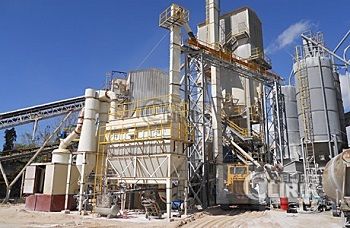
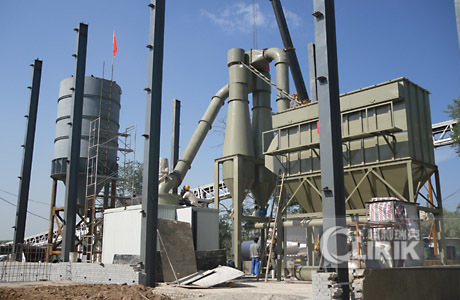
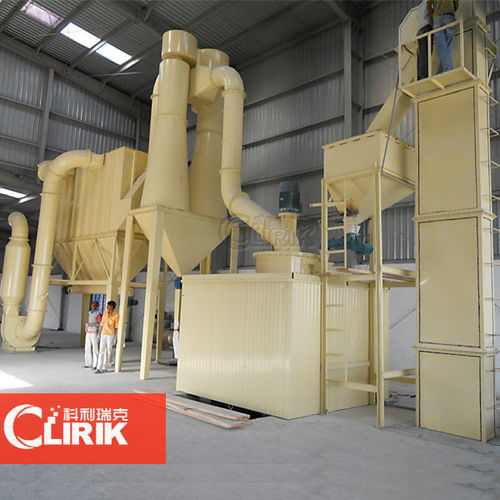
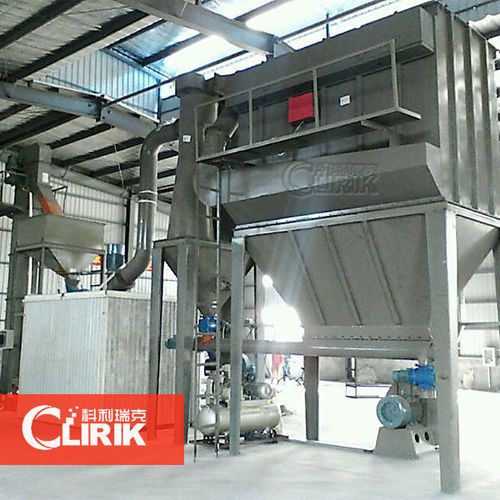
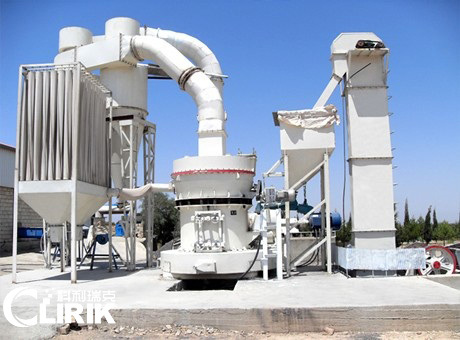
HGM series Grammite Grinding Mill mainly consist of main unit, classifier, powder collector, dust cleaner, blower, muffler, sound-proof room, crusher, bucket elevator, storage hopper, and vibrating feeder.
After crushed by hammer crusher, the large materials become small ones and are sent to storage hopper by elevator, and then evenly sent to the upper distribution plate of the turnplate by vibrating feeder and sloping feeding pipe.
When the grinding mill is at work, all the grinding rollers are rolling in the ring, and the materials are driven to the edge of the turnplate by the centrifugal force and fall down into the grinding chambers where the materials are repeatedly pressed, crushed and grinded by the rollers.
The high-pressure air blower constantly inhales air within the grinding mill and, in turn, the airflow with crushed materials are brought to the classifier whose high-speed impeller will screen the airflow: the unqualified particle size will fall and return to the mill for being reground while the qualified particle size mixed with air will go into the cyclone powder collector. Most of the qualified powders will fall and exit from the discharging valve at the bottom; a small proportion of the fine powders, with airflow, moves to the dust cleaner, and clings to the surface of the filter bags. At the same time, the fine powders clinging to the surface fall down by the sudden vibration of the filter bags, which is caused by the instantly ejected high-pressure gas controlled by the pulse valve. The materials from the above two lots are sent by the conveyor at the bottom to get finished powders packed. In addition, filtered clean air will be emitted from the air outlet of muffler in the end.
Features of Grammite Grinding Mill:
High efficiency
Under the same finished final size and the same motor power, the capacity of stone micronizer is twice as much as jet mill, mixing grinder and ball mill.
Long lifecycle of spare parts
The ring and roller are forged by special material with high utilization. Under the same grinding material and finish special size, the lifecycle of spare parts is about one year, which is 2-3times longer than impact mill or turbo mill. Furthermore, the lifetime can reach 2-5 years for grinding calcite carbonate.
High safety and reliability
As no rolling bearings or screws in grinding cavity, there are no problems caused by bolts shedding or rapid wear of bearings and seal components.
High fineness and flexible adjustment
The final fineness of the grinding materials can be adjusted between 325 meshes and 3000 meshes, and the product fineness can reach D975um.
Environment-friendly
The application of pulse deduster and muffler greatly alleviates dust pollution and noise.
Superior Surface PrecisionAchieve outstanding smoothness with a surface finish of up to 0.3 m Ra. The Grammite HGM grinding mill ensures consistent, high-quality results ideal for intricate metal, ceramic, or mineral components. The double V-type table slide way and high spindle speeds contribute to its exceptional precision, minimizing errors and enhancing the final product's accuracy.
Versatile Applications & Robust BuildThis grinder efficiently processes metals, ceramics, and minerals thanks to its variable working speeds and solid galvanized steel construction. Its 1250 kg weight and 1400 x 1000 mm floor space make it sturdy yet practical for busy workshops, factories, or supply facilities. The maximum table load of 160 kg and grinding length of 220 mm ensure compatibility with a broad range of workpieces.
User-Friendly & Efficient OperationWith manual or electrical controls and semi-automatic functionality, the Grammite HGM is accessible for various operator skill levels. Features like the 60-liter fuel tank, centralized lubrication system, and low-noise design support prolonged operations without frequent interruptions, while the standard coolant system preserves both the machine and the workpiece during grinding.
FAQ's of Grammite Grinding Mill:
Q: How is the Grammite HGM Grinding Mill operated?
A: The Grammite HGM accommodates both manual and electrical controls and works in semi-automatic mode, allowing operators to adapt to preferred working styles and requirements. It is not CNC or computerized, so hands-on control is essential.
Q: What materials can be processed with the Grammite Grinding Mill?
A: This grinding machine is engineered to handle metals, ceramics, and minerals, providing versatile performance across various industrial and manufacturing applications.
Q: When should I use the centralized lubrication system?
A: The centralized lubrication system operates continuously during machine use, automatically distributing lubricant to critical components. Regular checks are recommended to ensure optimal performance and extended service life.
Q: Where is the Grammite HGM typically installed and used?
A: With dimensions of 1400 x 1000 x 1600 mm and a robust build, this mill is ideal for installation in factories, workshops, supply depots, or industrial production facilities, especially where high-precision grinding is needed.
Q: What is the grinding process capability for this model?
A: The Grammite HGM offers a grinding length of 220 mm, maximum table load of 160 kg, and table travel of 450 mm. Combined with variable working and spindle speeds, it allows precise and efficient material removal, delivering high-quality finishes.
Q: How does the cooling and lubrication system benefit machine operation?
A: The standard coolant system and centralized lubrication reduce heat and friction, preventing workpiece distortion and machine wear. This extends machine lifespan, maintains accuracy, and allows longer periods of uninterrupted operation.
Q: What are the main advantages of using this grinding mill?
A: Key benefits include high-precision surface finishing, robust and long-lasting construction, low noise emission, and flexible usability for diverse grinding needs. The semi-automatic operation and variable speeds enhance productivity while supporting operator safety and comfort.





 Send Inquiry
 Send Inquiry


 Send Inquiry
 English
 Spanish
 French
 German
 Italian
 Chinese (Simplified)
 Japanese
 Korean
 Arabic
 Portuguese